Named Faces and Edges
Every feature can name its faces the way an extrude does: start, end, side and internal faces, and their edges (Name its faces). A feature can also give names of its own to parts of what it makes, so that the dialogs and models reach them by name. The gear below names its tooth tips, flanks, roots and bore. Rounding every tooth tip is then one choice in a right-click menu, and pinion.tipEdges() in code.
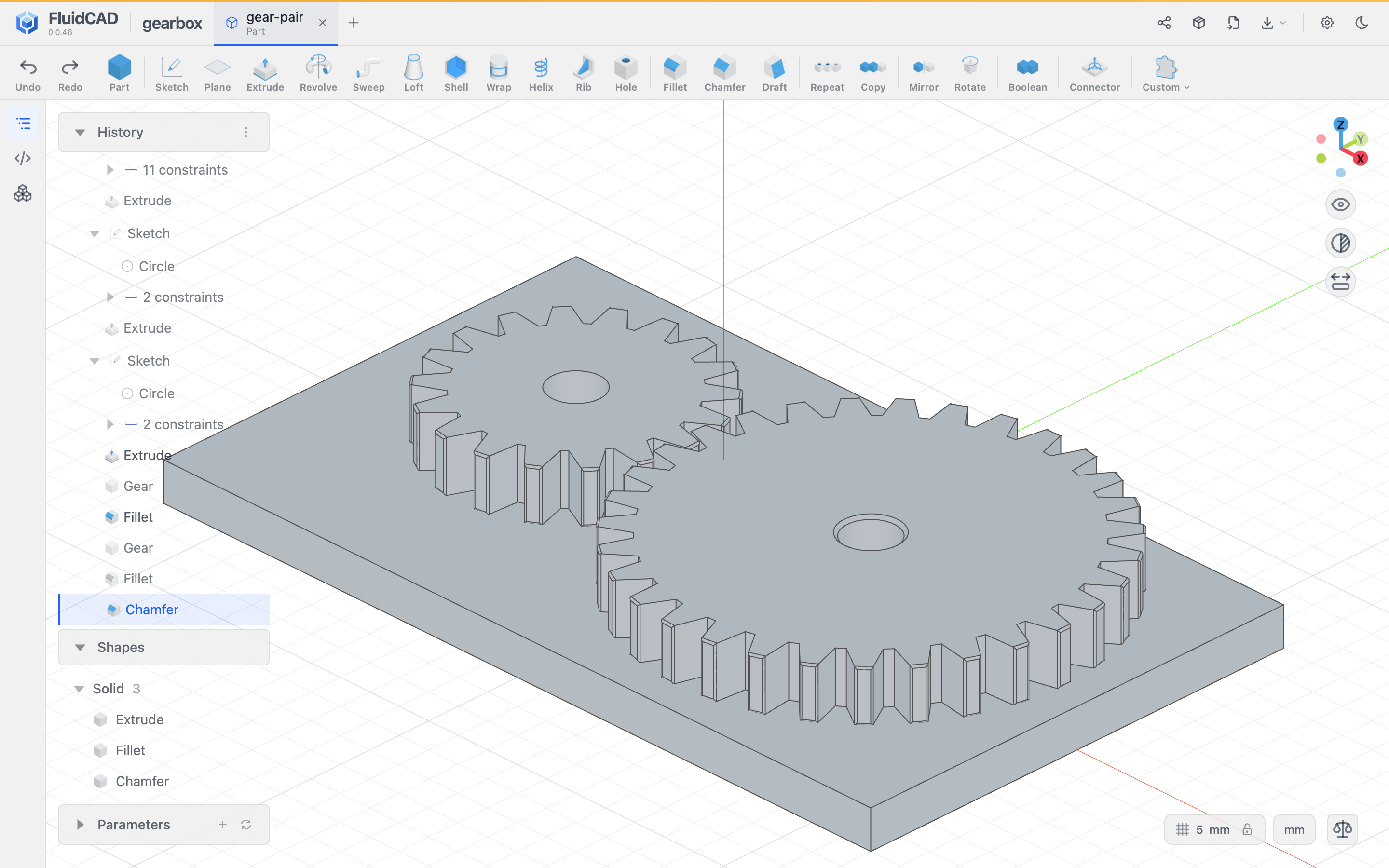
Declaring the names
The names are declared beside the inputs, as the second argument of Feature.with(), and filled in buildTool() with setBuckets():
export class Gear extends Feature.with({ /* the inputs */ }, {
  buckets: {
    tipFaces: {},
    tipEdges: {},
    flankFaces: {},
    rootFaces: {},
    boreFaces: {},
    boreEdges: { label: 'Bore Rims' },
  },
}) {
  // … in buildTool():
  this.setBuckets({ startFaces, endFaces, sideFaces, internalFaces, tipFaces, flankFaces, rootFaces, boreFaces });
- A name ends in
FacesorEdges, which says what it holds. Each becomes a method of the feature:pinion.tipEdges(), orwheel.boreEdges(0)with an index or a filter, asendEdges()takes them. The editor knows the names, sopinion.tipEdge()is marked as an error. - Declare the parts a user will fillet, chamfer or sketch on. Name the face the feature grows from
startFaces, not a name of your own. - An edge name exists only when it is declared.
tipEdgesis declared and left out ofsetBuckets(), so it holds every edge of the tip faces. labelis what the menus show after the feature's name: Gear Bore Rims. Without one, the menus show the name made readable: Gear Tip Edges.- Say what each name holds, and in what order, in the package's
docs/page for the feature (docs/gear.md): the tip faces one per tooth, in tooth order. A declaration takes no description. - A name misspelt in
setBuckets()fails the statement's row, with the name it was probably meant to be:gear: setBuckets() 'tipFace' is not a bucket of gear — did you mean tipFaces? - The names follow the operation. A gear added to a solid keeps what the solid still carries of each name. A feature that removes material keeps what its cut left, such as a pocket's floor. Each copy of a repeat has its own, moved with it.
The gear builds its outline with raw OpenCascade, since the kernel draws no outline. It tells the faces apart by the outline edge each one was swept from:
The whole gear
// A spur gear with straight flanks: a disc of `teeth` trapezoid teeth round a
// shaft bore, standing on a planar face, centred on it, or on the XY plane
// when no face is picked. Besides the standard buckets it names its own: the
// tooth tips, flanks and roots and the bore, and the edges of the tips and of
// the bore, which it leaves to be derived from their faces. It also publishes
// where it stands as a frame, `axis`, which the generated part in gear.part.js
// turns into a connector. The outline is built with raw OpenCascade
// (this.occ()), since the curated kernel draws no outline.
import { Feature, defineFeature } from 'fluidcad/sdk';
import { ShapeFactory, ShapeOps } from 'fluidcad/sdk/kernel';
import { Matrix4, Plane } from 'fluidcad/math';

/** The flanks' slant from the tooth's centre line: the old 14.5° rack, which keeps a root land down to ten teeth. */
const FLANK_ANGLE = (14.5 * Math.PI) / 180;

export class Gear extends Feature.with({
  // Optional, so a generated part can leave it out: the gear then stands on the XY plane.
  face: { picker: 'face', label: 'On face', surface: 'planar', optional: true, description: 'The planar face the gear stands on, centred on it; left empty, the XY plane' },
  teeth: { type: 'integer', default: 20, min: 10, max: 120, description: 'How many teeth go round the gear' },
  module: { type: 'length', default: 2, min: 0.2, description: 'The tooth size: the pitch diameter over the number of teeth' },
  thickness: { type: 'length', default: 8, min: 0, description: 'How far the gear stands off the face' },
  bore: { type: 'length', default: 8, min: 0, label: 'Bore diameter', description: 'The shaft hole through the middle; 0 leaves it solid' },
}, {
  // What the gear names, in the order the editor tries them.
  buckets: {
    tipFaces: {}, // the top land of every tooth, one per tooth, in tooth order
    tipEdges: {}, // the edges round the tip faces: where a fillet rounds the tooth tips
    flankFaces: {}, // the tooth flanks, two per tooth, in tooth order
    rootFaces: {}, // the bottom land between neighbouring teeth
    boreFaces: {}, // the wall of the shaft hole
    boreEdges: { label: 'Bore Rims' }, // the rims of the shaft hole, top and bottom
  },
  // Where the gear stands: origin on its axis, Z out of the gear, as a
  // connector on the face it stands on points, so a plain mate seats it.
  frames: {
    axis: { label: 'Gear axis' },
  },
}) {
  static id = 'gear';

  buildTool() {
    // The plane the gear stands on, and its centre on that plane.
    let plane = Plane.XY();
    let origin = plane.origin;
    if (this.values.face !== undefined) {
      const faces = this.facesOf(this.values.face);
      if (faces.length !== 1) {
        throw new Error(`gear: pick one planar face to stand on (got ${faces.length} faces)`);
      }
      plane = faces[0].getPlane();
      origin = plane.projectPoint(faces[0].center());
    }
    // The axis frame, set like the buckets: a plane at the gear's centre whose normal points out of
    // the gear, back into the face it stands on (the face's normal reversed; X kept: a half turn).
    this.setFrames({ axis: new Plane(origin, plane.xDirection, plane.normal.negate()) });
    const body = this.occ(scope => Gear.#body(scope, this.values));

    // Placed on the face, centred on it, growing along its normal.
    const all = body.solid.getSubShapes('face');
    const frame = Matrix4.fromBasis(plane.xDirection, plane.yDirection, plane.normal, origin);
    const placed = ShapeOps.transformTracking(body.solid, frame, all);
    body.solid.dispose();
    /** @param {number[]} indices */
    const imagesOf = indices => indices.map(i => placed.images[i]).filter(f => f !== null);
    const tipFaces = imagesOf(body.faces.tip);
    const flankFaces = imagesOf(body.faces.flank);
    const rootFaces = imagesOf(body.faces.root);
    const boreFaces = imagesOf(body.faces.bore);
    this.setBuckets({
      startFaces: imagesOf(body.faces.start),
      endFaces: imagesOf(body.faces.end),
      sideFaces: [...flankFaces, ...tipFaces, ...rootFaces],
      internalFaces: boreFaces,
      tipFaces, flankFaces, rootFaces, boreFaces,
    });
    return [placed.shape];
  }

  /**
   * The gear's outline on the XY plane, extruded along Z: for each tooth, a
   * flank, the tip land, the other flank, then the root land to the next
   * tooth, all on shared vertices so the wire takes the edges as they are.
   * The faces are told apart by the outline edge each one was swept from.
   *
   * @param {import('fluidcad/sdk/occt').OccScope} scope
   * @param {{ teeth: number, module: number, thickness: number, bore: number }} values
   */
  static #body({ oc, track }, { teeth, module, thickness, bore }) {
    const pitch = (module * teeth) / 2;
    const tip = pitch + module;
    const root = pitch - 1.25 * module;
    // Half the tooth's width, across its centre line, at the tip and at the root.
    const tipHalf = (Math.PI * module) / 4 - module * Math.tan(FLANK_ANGLE);
    const rootHalf = (Math.PI * module) / 4 + 1.25 * module * Math.tan(FLANK_ANGLE);
    const step = (2 * Math.PI) / teeth;
    if (step - 2 * Math.asin(rootHalf / root) <= 0) {
      throw new Error(`gear: ${teeth} teeth leave no room between them — give it more teeth`);
    }
    if (bore > 0 && bore / 2 >= root - module) {
      throw new Error(`gear: the bore (${bore}) leaves no rim under the teeth — keep it under ${(2 * (root - module)).toFixed(2)}`);
    }

    /** @param {number} radius @param {number} half @param {number} angle */
    const vertex = (radius, half, angle) => {
      const along = Math.sqrt(radius * radius - half * half);
      const x = along * Math.cos(angle) - half * Math.sin(angle);
      const y = along * Math.sin(angle) + half * Math.cos(angle);
      return track(new oc.BRepBuilderAPI_MakeVertex(new oc.gp_Pnt(x, y, 0)).Vertex());
    };
    const axis = new oc.gp_Ax2(new oc.gp_Pnt(0, 0, 0), new oc.gp_Dir(0, 0, 1));
    const tipCircle = new oc.gp_Circ(axis, tip);
    const rootCircle = new oc.gp_Circ(axis, root);

    const corners = Array.from({ length: teeth }, (_, i) => ({
      rootIn: vertex(root, -rootHalf, i * step),
      tipIn: vertex(tip, -tipHalf, i * step),
      tipOut: vertex(tip, tipHalf, i * step),
      rootOut: vertex(root, rootHalf, i * step),
    }));
    const wire = new oc.BRepBuilderAPI_MakeWire();
    /** @type {{ role: 'flank' | 'tip' | 'root', edge: import('fluidcad/sdk/occt').TopoDS_Edge }[]} */
    const roles = [];
    /** @param {'flank' | 'tip' | 'root'} role @param {import('fluidcad/sdk/occt').TopoDS_Edge} edge */
    const add = (role, edge) => {
      wire.Add(track(edge));
      roles.push({ role, edge: track(wire.Edge()) });
    };
    corners.forEach((c, i) => {
      const next = corners[(i + 1) % teeth];
      add('flank', new oc.BRepBuilderAPI_MakeEdge(c.rootIn, c.tipIn).Edge());
      add('tip', new oc.BRepBuilderAPI_MakeEdge(tipCircle, c.tipIn, c.tipOut).Edge());
      add('flank', new oc.BRepBuilderAPI_MakeEdge(c.tipOut, c.rootOut).Edge());
      add('root', new oc.BRepBuilderAPI_MakeEdge(rootCircle, c.rootOut, next.rootIn).Edge());
    });
    if (!wire.IsDone()) {
      throw new Error('gear: the outline did not close');
    }

    const face = new oc.BRepBuilderAPI_MakeFace(track(wire.Wire()), true);
    /** @type {import('fluidcad/sdk/occt').TopoDS_Edge | null} */
    let boreEdge = null;
    if (bore > 0) {
      boreEdge = track(new oc.BRepBuilderAPI_MakeEdge(new oc.gp_Circ(axis, bore / 2)).Edge());
      const boreWire = track(new oc.BRepBuilderAPI_MakeWire(boreEdge).Wire());
      // A hole runs the other way round from the outline.
      face.Add(track(oc.TopoDS.Wire(track(boreWire.Reversed()))));
    }
    const prism = new oc.BRepPrimAPI_MakePrism(track(face.Face()), new oc.gp_Vec(0, 0, thickness), false, true);
    if (!prism.IsDone()) {
      throw new Error('gear: the extrusion failed');
    }

    const solid = ShapeFactory.fromShape(track(prism.Shape()));
    const all = solid.getSubShapes('face');
    /** @param {import('fluidcad/sdk/occt').TopoDS_Shape} raw */
    const indexOf = raw => all.findIndex(f => f.getShape().IsSame(raw));
    /** @param {import('fluidcad/sdk/occt').TopoDS_Edge} edge */
    const sweptFrom = edge => {
      const list = track(prism.Generated(edge));
      /** @type {number[]} */
      const found = [];
      for (; list.Size() > 0; list.RemoveFirst()) {
        const at = indexOf(track(list.First()));
        if (at >= 0) {
          found.push(at);
        }
      }
      return found;
    };
    /** @type {Record<'start' | 'end' | 'tip' | 'flank' | 'root' | 'bore', number[]>} */
    const faces = {
      start: [indexOf(track(prism.FirstShape()))],
      end: [indexOf(track(prism.LastShape()))],
      tip: [],
      flank: [],
      root: [],
      bore: boreEdge ? sweptFrom(boreEdge) : [],
    };
    for (const { role, edge } of roles) {
      faces[role].push(...sweptFrom(edge));
    }
    return { solid, faces };
  }
}

export const gear = defineFeature(Gear, {
  label: 'Gear',
  description: 'A spur gear with straight flanks and a shaft bore, standing on a planar face',
  icon: './gear.svg',
  group: 'create',
  operations: ['add', 'new'],
  call: ['face', { teeth: 'teeth', module: 'module', thickness: 'thickness', bore: 'bore' }],
});
The gear's face is optional and it declares a frame, axis, beside its names: both serve its generated part, the gear an assembly inserts on its axis.
Using the names
In a dialog
-
Click Fillet and click the top edge of one tooth. The statement under the dialog writes the pick through the gear's own name:
pinion.tipEdges(…), with a filter that picks that edge. -
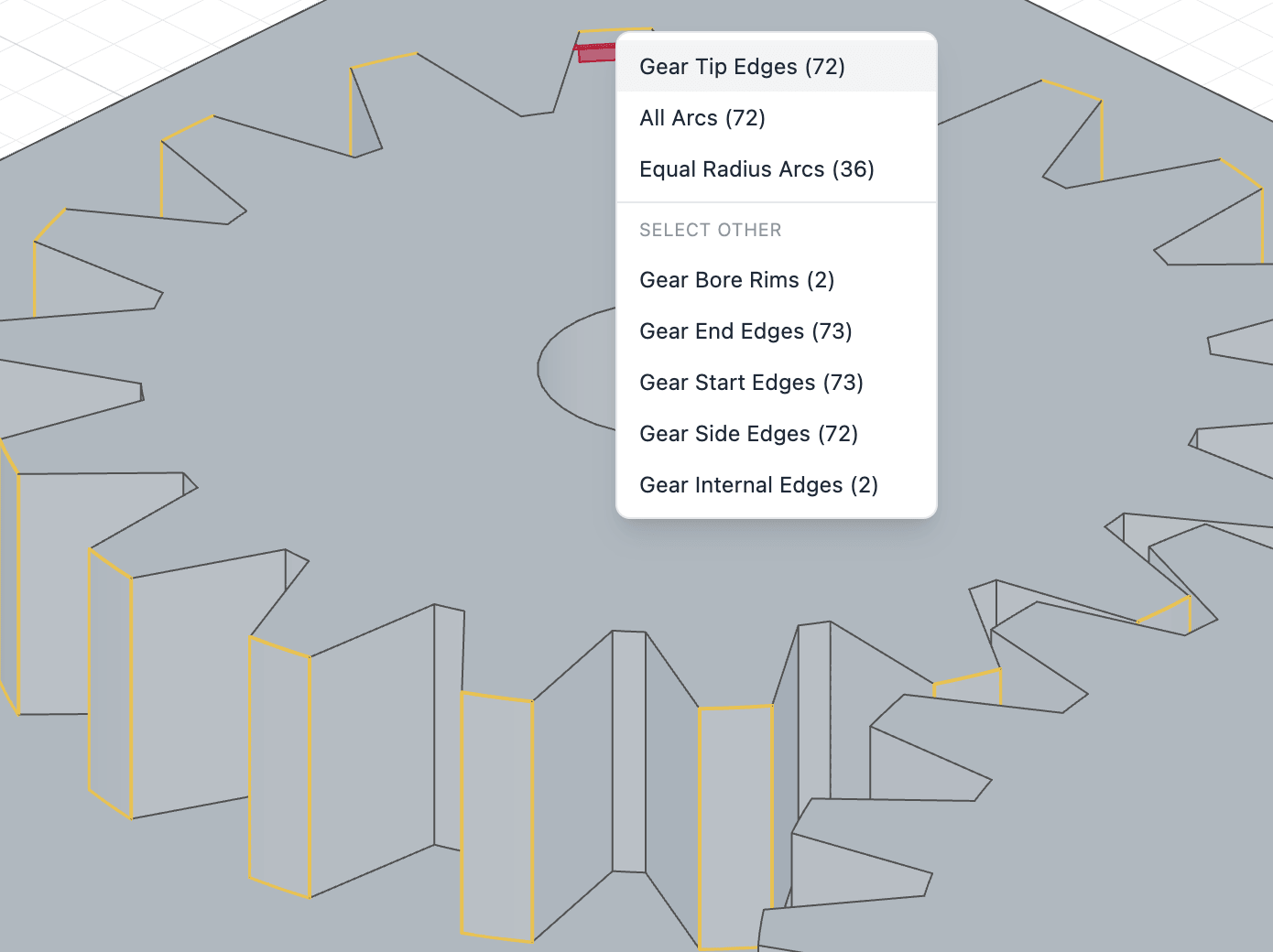
Right-click the edge. The menu leads with Gear Tip Edges (72): every edge round the tips of the pinion's 18 teeth. Hovering it highlights them. The gear's other names, such as Gear Bore Rims, and the standard names are under Select other.
-
Click Gear Tip Edges. The selection holds all 72 edges. Set Radius to 0.3, and the statement under the dialog reads
fillet(0.3, pinion.tipEdges()).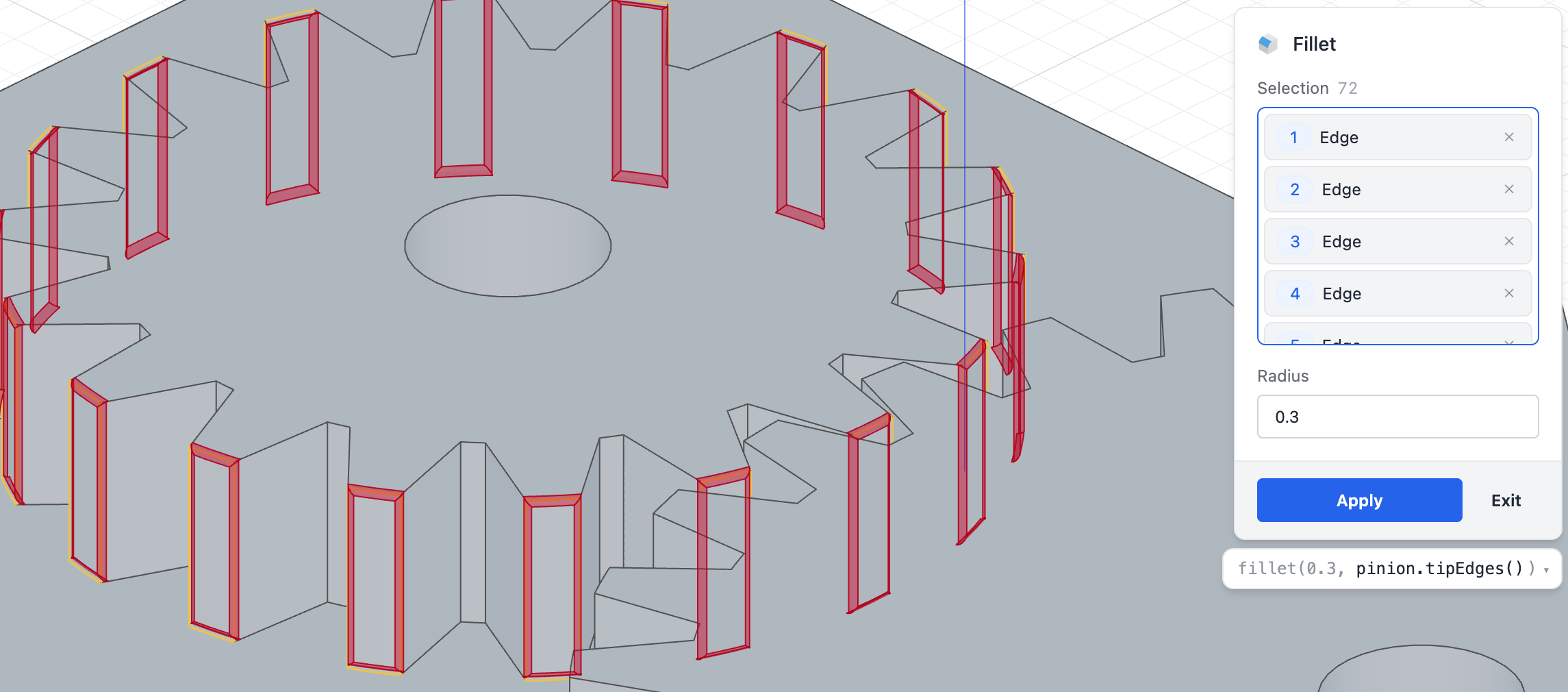
-
Click Apply. Every tooth tip of the pinion is rounded. Below, the wheel's tips are rounded the same way, and its bore takes a chamfer on Gear Bore Rims.
In code
The code behind it
import { part, sketch, line, circle, extrude, fillet, chamfer } from "fluidcad/core";
import { coincident, horizontal, vertical, distance, diameter, fix } from "fluidcad/constraints";
import { gear } from "./gear.feature.js";

// A gear pair on a 120 × 70 × 6 base plate: an 18-tooth pinion and a 31-tooth
// wheel, module 2, on round seats 50 mm apart (the sum of their pitch radii,
// 49, and 1 mm of backlash).
export const gearPair = part("Gear pair", () => {
  sketch("xy", () => {
    const b = line([-61, -36], [59, -34]);
    const r = line([59, -34], [61, 36]);
    const t = line([61, 36], [-59, 34]);
    const l = line([-59, 34], [-61, -36]);
    coincident(b.end(), r.start());
    coincident(r.end(), t.start());
    coincident(t.end(), l.start());
    coincident(l.end(), b.start());
    horizontal(b);
    vertical(r);
    horizontal(t);
    vertical(l);
    fix(b.start(), [-60, -35]);
    distance(b.start(), b.end(), 120);
    distance(r.start(), r.end(), 70);
  });
  extrude(6);

  // The two seats, 2 mm proud of the plate.
  sketch("xy", () => {
    const s = circle([-25, 0], 9);
    fix(s.center(), [-25, 0]);
    diameter(s, 20);
  });
  const pinionSeat = extrude(8);
  sketch("xy", () => {
    const s = circle([25, 0], 14);
    fix(s.center(), [25, 0]);
    diameter(s, 30);
  });
  const wheelSeat = extrude(8);

  // Each gear a body of its own on its seat (the New tab of the Gear dialog).
  const pinion = gear(pinionSeat.endFaces(), { teeth: 18 }).new();
  // Every tooth tip of the pinion: the gear's own Tip Edges, picked from the
  // right-click menu. A name the gear declares, read like endEdges().
  fillet(0.3, pinion.tipEdges());
  const wheel = gear(wheelSeat.endFaces(), { teeth: 31 }).new();
  fillet(0.3, wheel.tipEdges());
  // The top and bottom rims of the wheel's bore: the gear's Bore Rims.
  chamfer(0.5, wheel.boreEdges());
});
On a repeated gear, a pick on a copy is written r.instance(1).tipEdges(…).
These gears are New bodies. A gear added to the plate (Add) also counts the edges where each tip meets the plate among its tip edges, and a fillet can't round those together with the outer ones. There, keep the outer edges with a filter: fillet(0.3, pinion.tipEdges(edge().convex())).